Why Tire Shipping Costs What It Does
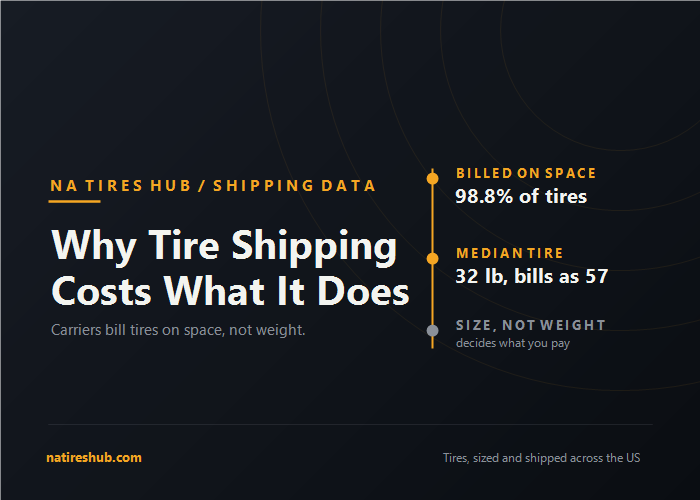
Table of contents
Most people assume a heavier tire costs more to ship. It is a reasonable assumption and it is mostly wrong.
We build our own shipping model, which meant sitting down with the published carrier tariffs and running them against every tire we stock. What came out was surprising enough that we decided to publish it, because nobody buying tires online has any real way to see how the number at checkout gets built.
Quick answer
Carriers do not bill a tire on what it weighs. They bill it on the space it takes up, using a calculation called dimensional weight. On 98.8 percent of the tires we stock, that dimensional figure comes out higher than the tire actually weighs. You are paying to ship air, and size drives the cost far more than weight does.
How dimensional weight works
Every major US ground carrier uses the same basic arithmetic. Take the length, width and height of the package in inches, multiply them together, and divide by 139. The result is the dimensional weight in pounds. The carrier then bills on whichever is higher, the dimensional weight or the actual weight.
That divisor of 139 is the whole story. It is set so that anything less dense than roughly 139 cubic inches per pound gets billed on volume instead of mass. A tire is a hollow ring. It is one of the least dense things you can hand a carrier.
We ran this across 4,336 in-stock tires, every product where we hold both a weight and a full size code. The picture is stark.
| Measure | Result |
|---|---|
| Tires where dimensional weight exceeds actual weight | 98.8% |
| Tires billed on actual weight | 54 out of 4,336 |
| Median actual weight | 32 lb |
| Median dimensional weight | 57 lb |
| Median ratio of dimensional to actual | 1.71x |
Fifty four products out of more than four thousand. Everything else is billed on the space it occupies.
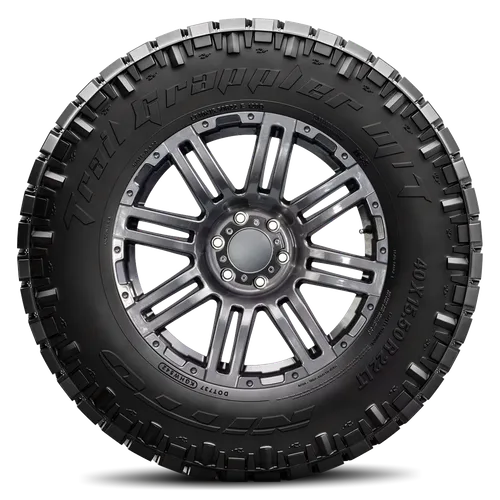
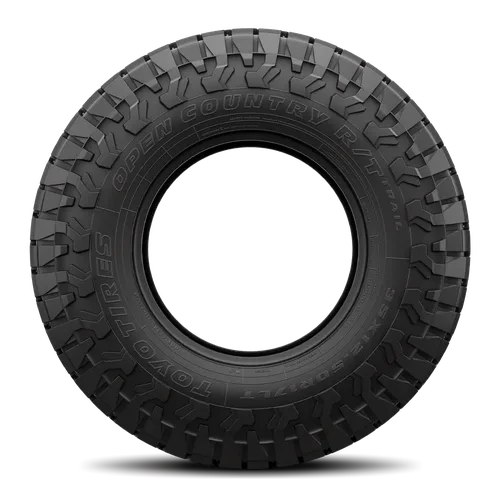
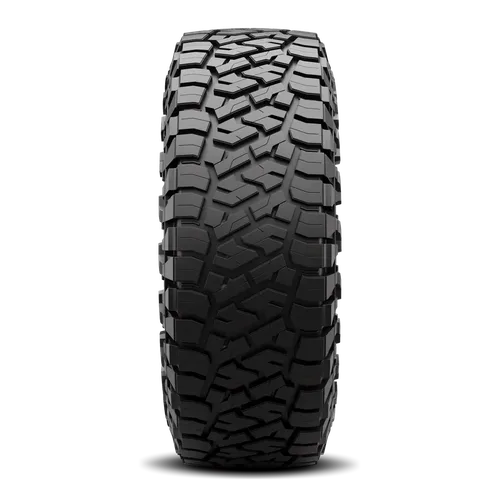
This is why two tires that weigh exactly the same can cost noticeably different amounts to deliver. Two tires in our catalogue both weigh 90 pounds on the scale. One is a 245/70R19.5 commercial tire, 32.5 inches across, and it works out to 73 pounds dimensional, which makes it one of the rare tires billed on its real weight. The other is an LT395/60R20 mud terrain, 38.7 inches across, and it works out to 167 pounds dimensional. Same weight. More than double the freight.
The surcharge nobody explains
Beyond the base rate, carriers apply what they call additional handling charges. These exist because some packages cannot go through automated sorting and need a person to move them.
There are three separate triggers, and tires interact with all of them differently.
By shape. The published packaging criteria list round and cylindrical items explicitly, and tires are named. This is the one that catches everything. A tire meets the criterion by being a tire. It does not matter whether it is a 13 inch trailer tire or a 24 inch truck tire. If it ships unboxed, it triggers the charge.
By dimension. This triggers when the longest side passes 48 inches, the second longest passes 30 inches, length plus girth passes 105 inches, or the package passes 10,368 cubic inches. On our catalogue, 53.3 percent of tires cross at least one of those thresholds unboxed, almost all of them on the cubic volume test.
By weight. This triggers above 50 pounds of actual weight. Here is where the common assumption breaks down completely. The median tire we stock weighs 32 pounds, and only 15.4 percent of the catalogue weighs more than 50 pounds.
So roughly one tire in seven triggers the weight surcharge. Every single one triggers the shape surcharge. Weight is the criterion people worry about and it is the least relevant of the three.
Distance matters less than you think
Carriers divide the country into zones based on how far a package travels. Common sense says a cross-country shipment should cost dramatically more than a local one. It does cost more, but nothing like the multiple people expect, and the reason is structural.
Base freight scales with zone. The surcharges do not. Additional handling is charged per package. Residential delivery is charged per package. Neither one cares whether the truck drove across town or across the country. On a tire, where those flat charges make up a large share of the total bill, they compress the difference between near and far.
The arithmetic is easier to see with a worked example. The figures below are illustrative, chosen to show how the components interact rather than quoted from any particular account, because real rates vary by contract, service level and a fuel surcharge that moves weekly.
| Component | Local delivery | Cross country |
|---|---|---|
| Base freight, scales with zone | $20 | $45 |
| Additional handling, flat | $20 | $20 |
| Residential delivery, flat | $6 | $6 |
| Total | $46 | $71 |
The base freight in that example more than doubles. The bill the customer sees rises by about half. That gap is the entire point. The further you ship, the smaller a share the flat charges represent, so the delivered price rises far more gently than raw distance suggests.
There is still a real step up once you are several zones out, and that is worth knowing if you live a long way from a distributor. But the popular idea that a tire from the other side of the country costs five times as much to deliver is not what the tariff structure produces.
The box question
Since the shape surcharge applies purely because a tire is round, putting it in a corrugated box removes it. That seems like an obvious fix. It is not, and the numbers show why.
Boxing adds roughly an inch to each dimension. On a smaller tire that is harmless. On a larger one it pushes the package further into the dimension thresholds, so you remove one surcharge and keep another.
| Outcome when boxed | Share of catalogue |
|---|---|
| Becomes completely surcharge free | 32.4% |
| Still surcharged, no benefit | 65.8% |
| Pushed into the oversize bracket, actively worse | 1.8% |
So boxing helps on about one tire in three and does nothing at all on two in three. It is a real saving on the tires it fits and an added cost everywhere else, which means a blanket policy in either direction is the wrong call. It has to be decided per tire.
The group it does help is worth noting. Those are the smaller, cheaper tires, which is exactly the segment where a fixed surcharge does the most damage as a share of the price.
When delivery costs a lot relative to the tire
The cheapest tire in our catalogue is a 165/70R13 at $39.06. It weighs 16 pounds and measures 22.1 inches across by 6.5 inches wide, which works out to 3,171 cubic inches and a dimensional weight of 23 pounds. It is a small, light, inexpensive tire, and it still triggers the shape surcharge, because every tire does.
Just under 19 percent of what we stock sells for less than $80. On tires in that band, a flat additional handling charge plus a residential delivery charge can approach or exceed what the tire itself costs when it is going to a distant address, before any base freight is added.
At the other end, an LT395/60R20 mud terrain weighs 90 pounds and measures 38.7 inches across, giving 23,244 cubic inches and a dimensional weight of 167 pounds. That one is expensive to ship because it genuinely is enormous.
Both ends of the catalogue are awkward for different reasons. This is a structural feature of shipping goods that are large, light and, at the budget end, cheap. It is not unique to any one retailer.
Key takeaways
- Carriers bill tires on dimensional weight, not actual weight, on 98.8 percent of what we stock.
- The median tire weighs 32 pounds but bills as though it weighs 57.
- Every tire triggers the shape surcharge. Only about one in seven is heavy enough to trigger the weight surcharge.
- Shipping surcharges are flat per package, so they do not rise with distance. That is why cross country costs far less extra than people expect.
- Boxing removes the shape surcharge on about a third of tires and changes nothing on the rest.
- Compare the delivered total between retailers, never the sticker price.
What this means for free shipping
Shipping is never free. It is a real cost paid to a real carrier, and someone always pays it.
When a retailer advertises free shipping, that cost has been folded into the product price. That is a legitimate way to run a business and plenty of good companies do it. But it means every customer pays an average, which quietly means customers near the warehouse subsidize customers far from it, and customers buying small tires subsidize customers buying large ones.
The alternative is to show the freight as its own line, quoted against the address you are actually shipping to. That is less tidy at first glance. It is also the only version where the number in front of you reflects what it costs to get that specific tire to your specific door.
Neither approach is dishonest. But knowing which one you are looking at makes the comparison between two retailers much more meaningful, because a sticker price with delivery built in and a sticker price without are not the same number.
The verdict
Compare the delivered total, never the sticker price. Two quotes are only comparable at the final checkout figure, and this is the single most useful habit when buying tires online.
Beyond that, three things are worth knowing. Check whether your delivery address counts as residential or commercial, because residential carries a per package charge that commercial does not, and a business address is genuinely cheaper if you have one. Buy a full set in a single order where you can, since some per order costs are fixed and splitting a set can cost more than keeping it together. And do not assume a heavier tire ships for more, because size drives the bill and weight mostly does not.
Methodology
The catalogue analysed is 4,336 in-stock tires, every product in our live inventory carrying both a weight and a complete size code. Package dimensions were derived from the size code: overall diameter from the rim diameter plus twice the section height, and package width from the section width. Dimensional weight uses the standard 139 divisor applied to the unboxed tire, since most tires ship without a box. The boxed scenario adds one inch to each dimension. Surcharge thresholds are the published criteria from the carriers 2026 service guides.
Three limitations are worth stating plainly. Dimensions are derived from size codes rather than measured on physical product, so individual tires vary by a fraction of an inch. Surcharge stacking, meaning whether multiple additional handling charges apply together or only the highest applies, is treated here as highest only. And the zone illustration above uses representative figures to show how the components combine, not quoted rates, because published rates are modified by contract terms and a fuel surcharge that changes weekly.
Everything here is derived from published carrier rate cards and our own live catalogue, both of which can be checked independently.
Ready for new tires?
Search live prices in your exact size, shipped from our US warehouses.
Shop tires by sizeFrequently Asked Questions
Have questions? We've got answers.
Sources & references
- FedEx Service Guide 2026, additional handling and oversize criteria, and dimensional weight calculation.
- UPS Tariff and Terms of Service, dimensional weight and additional handling charges.
- U.S. Tire Manufacturers Association, tire construction and specification references
Disclaimer: This content is for general informational purposes only and is not a substitute for professional automotive advice. Always confirm tire size, load rating, and inflation pressure against your vehicle's door placard and owner's manual, and consult a qualified tire professional before making changes to your vehicle's tires.