What Size Is a 33 Inch Tire? Metric Sizes for 33s and 35s
Table of contents
"33 inch tires" and "35 inch tires" are how most truck and Jeep owners talk about size, but almost every tire on the shelf is labeled in metric. A 33 might be sold as 285/75R16, 275/60R20 or 33x12.50R20, and only one of those has the number 33 in it. Here are the metric sizes that make a 33 and a 35, worked out to the tenth of an inch, and how to read the flotation sizes that skip metric altogether.
Quick answer
A 33 inch tire is any size with an overall diameter of about 33 inches. The common metric 33s are 285/75R16, 285/70R17, 275/70R18, 275/60R20 and 305/55R20. The flotation size 33x12.50R20 is labeled in inches directly. A 35 in metric is usually a 315/70R17, 315/75R16 or 295/65R20.
Why a 33 inch tire has a metric size
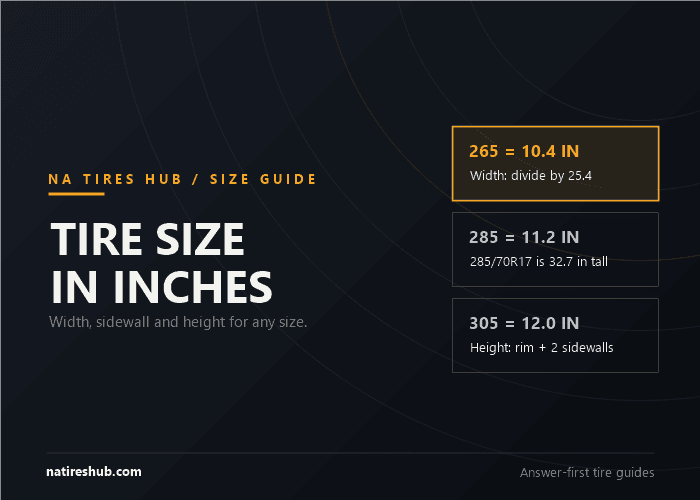
The "33" is the overall diameter: the height of the tire from the ground to the top of the tread. A metric size does not print that number. It gives you the width in millimeters, the sidewall as a percentage of that width, and the wheel diameter in inches, so the height has to be worked out:
- Multiply the width by the aspect ratio and divide by 100 to get the sidewall in millimeters.
- Divide by 25.4 to turn it into inches.
- Add the sidewall twice, once above the wheel and once below, to the wheel size.
For a 285/75R16 that is 285 times 0.75, or 213.75 mm, which is 8.4 inches. Then 16 plus 8.4 plus 8.4 gives 32.8 inches. That is a 33 inch tire. The full method, with a chart of widths, is in our guide to tire size in inches.
Metric sizes that make a 33 inch tire
Anything from about 32.5 to 33.5 inches is sold and talked about as a 33. These are the common ones, grouped by wheel size. Select a size to see the tires we have in it.
| Tire size | Wheel (in) | Width (in) | Overall diameter (in) |
|---|---|---|---|
| 285/75R16 | 16 | 11.2 | 32.8 |
| 285/70R17 | 17 | 11.2 | 32.7 |
| 265/70R18 | 18 | 10.4 | 32.6 |
| 285/65R18 | 18 | 11.2 | 32.6 |
| 275/70R18 | 18 | 10.8 | 33.2 |
| 275/60R20 | 20 | 10.8 | 33.0 |
| 305/55R20 | 20 | 12.0 | 33.2 |
| 285/60R20 | 20 | 11.2 | 33.5 |
| 275/50R22 | 22 | 10.8 | 32.8 |
| 305/45R22 | 22 | 12.0 | 32.8 |
Two things stand out. First, the same height is possible on every common wheel size from 16 to 22 inches, because a bigger wheel simply gets a shorter sidewall. Second, the widths differ by well over an inch. A 265/70R18 and a 305/55R20 are both 33s, but the 305 is about 1.6 inches wider, and that matters more for fender and suspension clearance than the extra tenth of height.
Is a 285 a 33 inch tire?
Sometimes. The 285 is only the width, about 11.2 inches. Whether the tire is a 33 depends on the aspect ratio and the wheel:
- 285/75R16: 32.8 inches. Yes, this is the classic 33.
- 285/70R17: 32.7 inches. Yes.
- 285/65R18: 32.6 inches. Yes, at the short end.
- 285/60R20: 33.5 inches. Yes, at the tall end.
- 285/55R20: 32.3 inches. Closer to a 32.
- 285/60R18: 31.5 inches. No, this is a 31 to 32.
- 285/45R22: 32.1 inches. No, this is a 32.
The same applies to 275s: a 275/70R18 at 33.2 inches and a 275/60R20 at 33.0 inches are 33s, while a 275/65R18 at 32.1 inches is not quite.
Metric sizes that make a 35 inch tire
True 35s are rare in metric. Most of the sizes sold as metric 35s are a little under 35 inches tall, and the flotation sizes in the next section are far more common at this height.
| Tire size | Wheel (in) | Width (in) | Overall diameter (in) |
|---|---|---|---|
| 315/75R16 | 16 | 12.4 | 34.6 |
| 315/70R17 | 17 | 12.4 | 34.4 |
| 295/70R18 | 18 | 11.6 | 34.3 |
| 285/65R20 | 20 | 11.2 | 34.6 |
| 295/65R20 | 20 | 11.6 | 35.1 |
| 325/60R20 | 20 | 12.8 | 35.4 |
The 315/70R17 is the size most people mean by "a 35 in metric". It is about 0.6 inches shorter than a true 35, which is why some owners who want the full height move to a 35x12.50R17 instead. In between, the 275/65R20 at 34.1 inches is often described as a 34.
Flotation sizes: 33x12.50R20 and 35x12.50R20
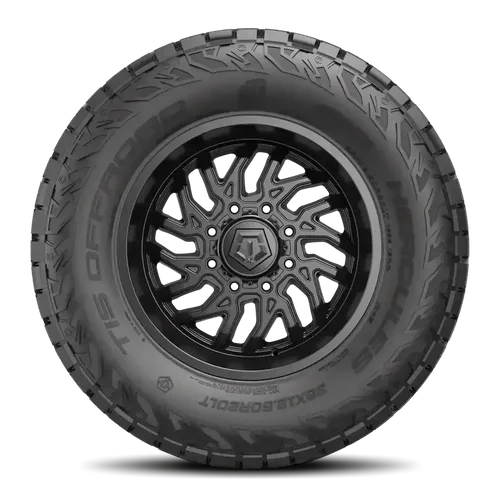
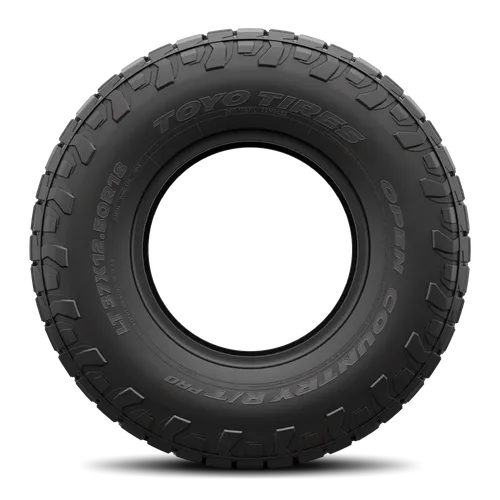
Many off-road and light truck tires use flotation sizing, which is already in inches. A 33x12.50R20 reads as:
- 33: overall diameter, about 33 inches.
- 12.50: section width, about 12.5 inches.
- R: radial construction.
- 20: wheel diameter, 20 inches.
Often the size ends in LT, as in 33x12.50R20LT, which marks a light truck tire with a light truck load range. The common flotation sizes at these heights:
- 33 inch: 33x12.50R15, 33x12.50R17, 33x12.50R18, 33x12.50R20, 33x12.50R22
- 35 inch: 35x12.50R17, 35x12.50R18, 35x12.50R20, 35x12.50R22, 35x13.50R20
- 37 inch: 37x12.50R20, 37x13.50R20, 37x13.50R22
The height in a flotation size is a nominal figure. A mounted tire sold as a 33 often measures a little under 33 inches, and the exact number varies by brand and tread pattern, so check the manufacturer's spec sheet when clearance is tight.
What is 33x12.50R20 in metric?
No metric size matches a flotation size exactly, because a 12.50 inch width works out to about 317 mm, which falls between the metric widths. The closest matches by height:
| Flotation size | Closest metric size | Metric diameter (in) | Metric width (in) |
|---|---|---|---|
| 33x12.50R17 | 285/70R17 | 32.7 | 11.2 |
| 33x12.50R18 | 275/70R18 | 33.2 | 10.8 |
| 33x12.50R20 | 305/55R20 | 33.2 | 12.0 |
| 33x12.50R22 | 305/45R22 | 32.8 | 12.0 |
| 35x12.50R17 | 315/70R17 | 34.4 | 12.4 |
| 35x12.50R18 | 295/70R18 | 34.3 | 11.6 |
| 35x12.50R20 | 295/65R20 | 35.1 | 11.6 |
Most of the metric options are narrower than the flotation tire they replace. That is often the point: a narrower tire at the same height can clear where a full 12.50 does not.
Know the size you want? Search it to see the tires available in it:
Find tires in your size
It's on your tire's sidewall or the driver-side door placard — e.g. 205/55R16
Before you move up to 33s or 35s
A taller tire changes more than the look of the truck. Four things to check first:
- Clearance. Some full-size pickups clear a 33 with little or no change. Many smaller trucks and SUVs need a leveling kit, and 35s usually need a lift. Wheel offset and width matter as much as the tire. A tire shop or the suspension manufacturer can confirm what fits your vehicle.
- Speedometer. A taller tire covers more ground per turn, so the speedometer reads low. Going from a 265/70R17 at 31.6 inches to a 33.0 inch tire is about 4 percent taller: at an indicated 60 mph you are doing about 62.7. Going from 32.8 to 35.0 inches is about 7 percent, or roughly 64 mph at an indicated 60.
- Load rating. Flotation and LT sizes carry light truck load ranges such as C, D or E. A passenger metric size of the same height can carry a different load index. Check the load rating against your door placard, especially if you tow.
- Weight and gearing. Taller tires are heavier and effectively change your final drive ratio. Expect slower acceleration and lower fuel economy, more so with 35s than 33s.
Key takeaways
- A 33 inch tire is any size with an overall diameter of about 32.5 to 33.5 inches.
- Common metric 33s: 285/75R16, 285/70R17, 275/70R18, 275/60R20, 305/55R20 and 305/45R22.
- A 285 is a 33 only with the right aspect ratio and wheel: 285/75R16 and 285/70R17 are, 285/60R18 is not.
- Metric 35s are usually a little short: 315/70R17 is 34.4 inches, 295/65R20 is 35.1.
- Flotation sizes such as 33x12.50R20 are already in inches: height, width, then wheel.
- Check clearance, load rating and speedometer error before moving up a size.
The verdict
A 33 or a 35 is a height, not a size. To find one in metric, work out the overall diameter from the width, aspect ratio and wheel, or use the charts above. The metric choices on each wheel size let you pick a narrower or wider tire at the same height, and the flotation sizes give you the full 12.50 width. Whichever you choose, confirm it clears your vehicle and carries the load rating on your door placard before you buy. For the rest of the numbers on the sidewall, see our guide to what tire numbers mean.
Ready for new tires?
Search live prices in your exact size, shipped from our US warehouses.
Shop tires by sizeFrequently Asked Questions
Have questions? We've got answers.
Sources & references
Disclaimer: This content is for general informational purposes only and is not a substitute for professional automotive advice. Always confirm tire size, load rating, and inflation pressure against your vehicle's door placard and owner's manual, and consult a qualified tire professional before making changes to your vehicle's tires.