Tire Aspect Ratio Explained: What the Middle Number Means
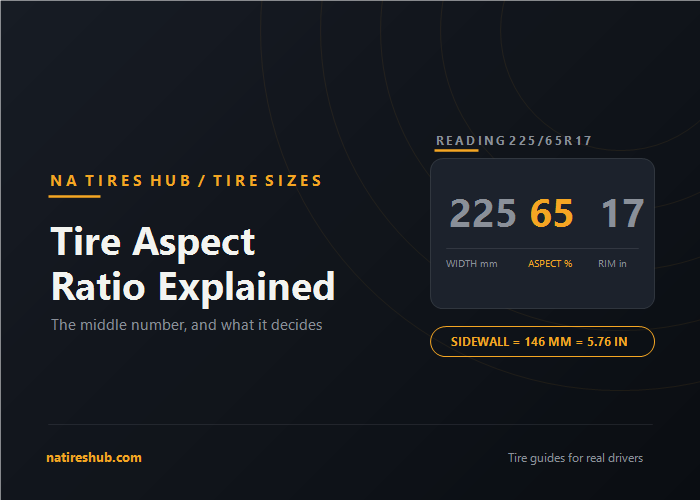
Table of contents
In a tire size like 225/65R17, almost everyone reads the first number and the last one. The middle number gets skipped. That middle number is the aspect ratio, and it decides how tall your sidewall is, which in turn decides how the car rides, how it steers, and how much protection your wheels have against potholes.
Quick answer
The aspect ratio is the middle number in a tire size, and it is the sidewall height written as a percentage of the tire's width. In 225/65R17 the 65 means the sidewall is 65 percent of 225 mm, so about 146 mm tall. A lower number means a shorter sidewall.
What the aspect ratio number actually means
It is a percentage, not a measurement. The aspect ratio tells you how tall the sidewall is compared to how wide the tire is.
Take 225/65R17. The 225 is the section width in millimetres. The 65 is the aspect ratio. So the sidewall height is 65 percent of 225 mm.
This is why the same aspect ratio produces different sidewall heights on different tires. A 65 on a narrow 185 mm tire gives a much shorter sidewall than a 65 on a wide 285 mm tire, because it is 65 percent of a different number each time.
How to calculate sidewall height from the aspect ratio
The arithmetic is straightforward, and it is worth knowing because it is the only way to compare two sizes properly.
Sidewall height = section width in mm, multiplied by the aspect ratio, divided by 100.
For 225/65R17:
- 225 mm width, multiplied by 65, divided by 100, gives 146.25 mm of sidewall
- Divide by 25.4 to convert to inches: 5.76 inches
- The tire has a sidewall above and below the wheel, so overall diameter is 17 inches plus twice 5.76, which is 28.5 inches
Run the same sum on a low-profile size like 245/40R18 and you get 98 mm of sidewall, or 3.86 inches, for an overall diameter of 25.7 inches. Wider tire, much shorter sidewall, smaller overall diameter.
What common aspect ratios mean in practice
| Aspect ratio | Sidewall | Usually found on |
|---|---|---|
| 30 to 40 | Very short | Performance cars on large wheels |
| 45 to 55 | Short | Sporty sedans, modern crossovers |
| 60 to 65 | Medium | Family sedans, most SUVs |
| 70 to 75 | Tall | Older cars, light trucks, trailers |
| 80 and above | Very tall | Work trucks, off-road, commercial |
Lower is not better and higher is not safer. They are different trades, and the right one is the one your vehicle was engineered around.
How the aspect ratio changes the way a car drives
The sidewall is the flexible part of a tire. Its height controls how much it can flex, and that single fact explains most of the difference between a low-profile tire and a tall one.
A taller sidewall absorbs more of the road. Bumps and potholes are softened before they reach the cabin, the ride is more comfortable, and there is more rubber between a pothole edge and your wheel rim. The cost is a small delay between turning the wheel and the car responding, because that taller sidewall flexes under load first.
A shorter sidewall flexes less, so steering feels more immediate and the car holds a line more precisely. The cost is a firmer ride, more road noise, and far less protection for the wheel. On a low-profile tire, a pothole that would have been absorbed can instead crack the rim.
If you already know your size and want to see what is available in it, this is the point to check:
Find tires in your size
It's on your tire's sidewall or the driver-side door placard — e.g. 205/55R16
What happens if you change the aspect ratio
Changing the middle number changes the overall diameter of the tire, and that has consequences beyond fit.
Your speedometer and odometer are calibrated to the original diameter. Fit a taller tire and the car travels further per wheel revolution, so the speedometer reads lower than your true speed. Fit a shorter one and it reads higher. The same applies to the odometer, and to systems that rely on wheel speed such as ABS, stability control and the tire pressure monitoring system.
The usual industry guidance is to stay within roughly 3 percent of the original overall diameter. That is why plus-sizing normally pairs a larger wheel with a lower aspect ratio: going up an inch on the rim and down a step on the aspect ratio keeps the overall diameter close to where it started.
Two things do not change with the aspect ratio and must not be compromised. The load index and the speed rating have to match or exceed what the door placard calls for, whatever size you end up in. Fitment also has to clear your suspension and bodywork at full lock and full compression, which is a question for a tire professional rather than a calculator.
Key takeaways
- The aspect ratio is the middle number in a tire size, and it is a percentage, not a measurement.
- Sidewall height equals the section width in millimetres, multiplied by the aspect ratio, divided by 100.
- In 225/65R17 the sidewall is 146 mm, or 5.76 inches, giving an overall diameter of 28.5 inches.
- A taller sidewall means a softer ride and better wheel protection. A shorter one means sharper steering and a firmer ride.
- Changing the aspect ratio changes overall diameter, which affects the speedometer, the odometer and wheel-speed systems.
- The door placard is the size to trust, and load index and speed rating must never be downgraded.
Aspect ratio on light truck and flotation sizes
Not every tire size uses this format. Flotation sizes, the ones written like 33x12.50R20, state the overall diameter and width in inches directly and carry no aspect ratio at all. If you run an off-road or lifted truck, those are the numbers you will be comparing instead.
Light truck sizes marked LT do use an aspect ratio, but they tend to sit at the taller end of the scale. That is deliberate: a taller sidewall carries load better and survives rough surfaces, which is exactly what those tires are built for.
The verdict
The aspect ratio is the number that decides whether your car rides softly or steers sharply, and it is the one most people never look at. You do not need to memorise anything about it. You need to know that it is a percentage of the width, that it sets your sidewall height, and that changing it changes your overall diameter along with everything calibrated to it.
When you replace tires, the safest answer is the size on your door placard. If you want to change it, work out the overall diameter first, keep it within about 3 percent of the original, and confirm the load index and speed rating still meet what your vehicle requires.
Ready for new tires?
Search live prices in your exact size, shipped from our US warehouses.
Shop tires by sizeFrequently Asked Questions
Have questions? We've got answers.
Sources & references
Disclaimer: This content is for general informational purposes only and is not a substitute for professional automotive advice. Always confirm tire size, load rating, and inflation pressure against your vehicle's door placard and owner's manual, and consult a qualified tire professional before making changes to your vehicle's tires.